MRR / ARR Calculator
Turn subscribers and pricing into predictable revenue. Enter your active customers and average revenue per customer to get monthly recurring revenue (MRR) and annual recurring revenue (ARR) instantly, with the formula explained and worked examples.
Calculate your MRR & ARR
How to calculate MRR and ARR
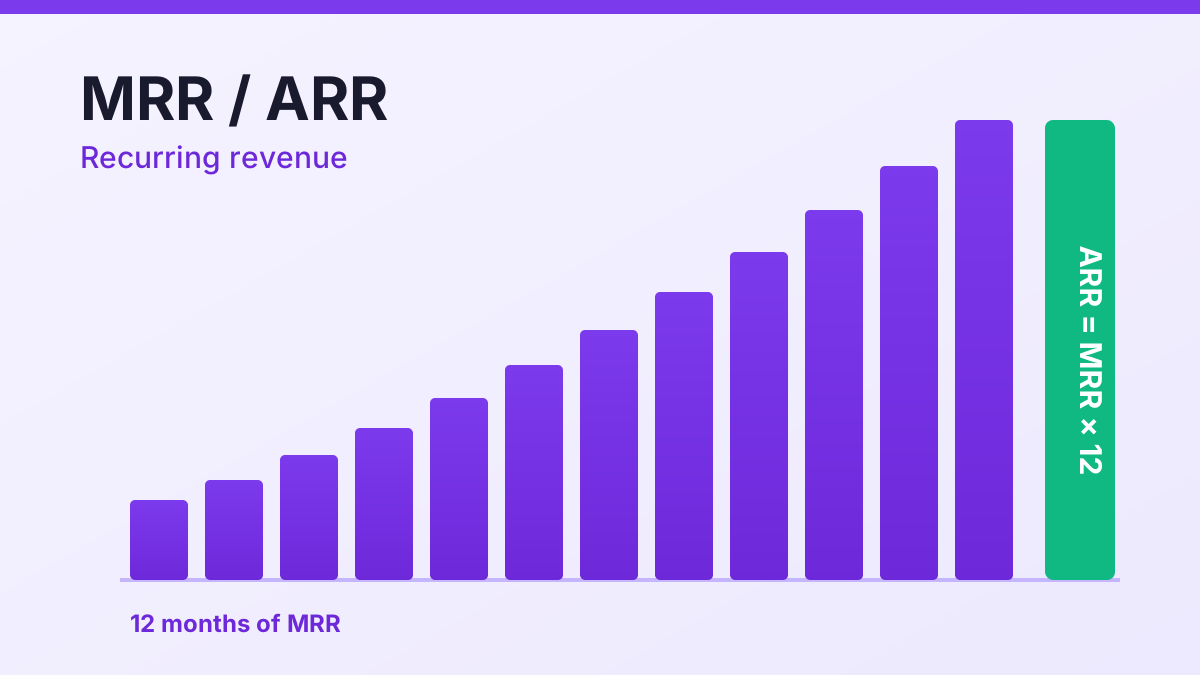
How to calculate MRR is a single multiplication: active customers times the average revenue each pays per month. With 500 customers paying $80 a month, MRR is 500 × $80 = $40,000. Annual recurring revenue follows directly — ARR = MRR × 12 = $480,000.
This mrr calculator runs both figures at once and, if you add a growth rate, projects them a year forward. The only rule that trips people up in the mrr calculation is what counts as recurring, which the section below clears up.
MRR to ARR at a glance
Because ARR is just MRR multiplied by twelve, the two move together. These examples show how customer count and pricing combine into recurring revenue.
| Active customers | Avg revenue / customer | MRR | ARR |
|---|---|---|---|
| 100 | $50 | $5,000 | $60,000 |
| 500 | $80 | $40,000 | $480,000 |
| 1,000 | $120 | $120,000 | $1,440,000 |
Small moves in average revenue per customer compound fast at scale: raising ARPA from $80 to $120 on 1,000 customers adds $480,000 to ARR without winning a single new account.
How to use this calculator
- Enter your active customers. Count only paying subscribers on recurring plans. Contacts on free trials or one-time buyers do not belong in the mrr calculation.
- Add average revenue per customer. Enter the average monthly recurring revenue per account. This mrr calculator multiplies it by your customer count to return MRR, then ARR.
- Optionally project your growth. Add a monthly growth rate to see where MRR and annual recurring revenue land twelve months out at your current pace.
Frequently asked questions
How do you calculate MRR?
Multiply your active customers by the average recurring revenue each pays per month. 500 customers at $80 a month is $40,000 MRR. That is all there is to how to calculate MRR, and the tool above also returns your ARR.
What is the difference between MRR and ARR?
MRR is recurring revenue measured per month; ARR is the same revenue expressed per year. ARR = MRR × 12. Monthly subscription businesses tend to quote MRR, while annual-contract SaaS companies usually report ARR.
What should you exclude from the MRR calculation?
Leave out anything that does not recur: one-time setup fees, usage overages, and one-off services. Including them overstates MRR and makes growth look better than it is. Only predictable subscription revenue belongs in the number.
Is ARR just MRR times 12?
Yes. ARR is a forward-looking projection of the recurring revenue you have today, so it equals current MRR multiplied by twelve. It assumes your MRR holds steady, which is why you track churn and growth alongside it.
What counts in the MRR calculation
MRR should include only predictable, recurring subscription revenue. Exclude one-time setup fees, usage overages, and professional-services charges, because they do not repeat and inflate the number. Normalize billing terms too: for annual plans, divide the contract value by twelve so a $1,200 yearly plan counts as $100 of MRR, not a $1,200 spike in one month. Getting this right keeps ARR — and any growth projection built on it — honest.