Payback Period Calculator
See how many months of revenue it takes to earn back what you spent acquiring a customer. Enter your CAC and monthly revenue per customer to get the payback in months, with the formula explained and 2026 SaaS benchmarks for context.
Calculate your payback period
How to calculate the CAC payback period
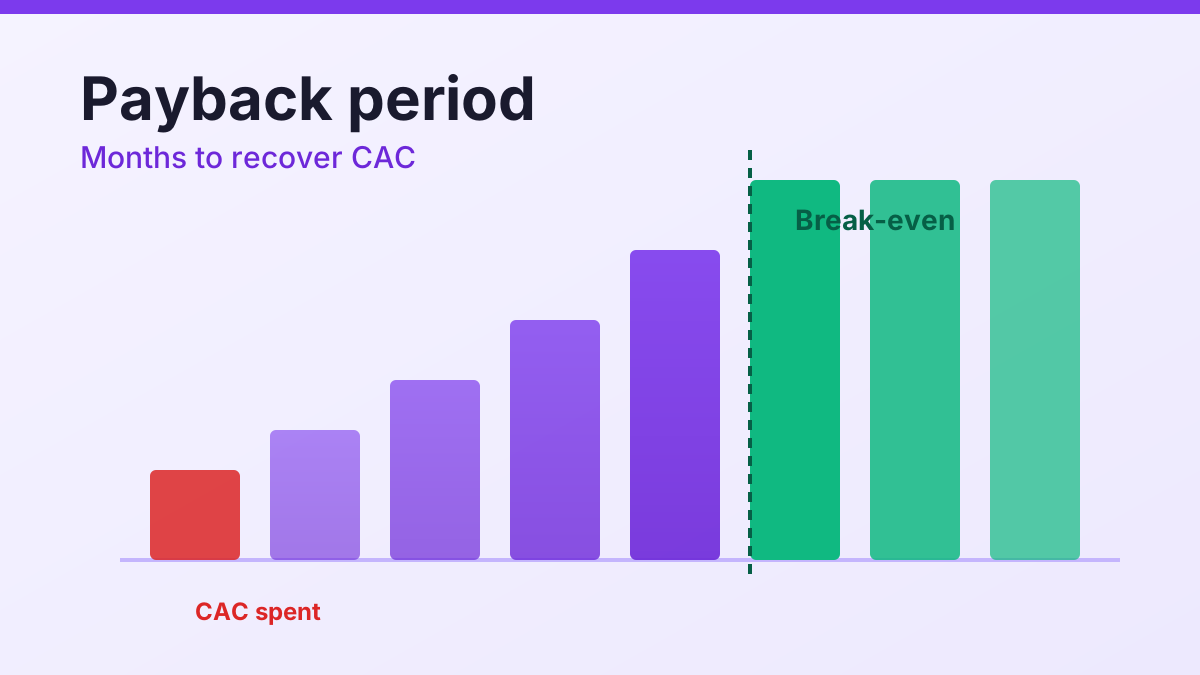
To work out your cac payback period, divide customer acquisition cost by the monthly revenue each customer pays. If CAC is $1,200 and a customer pays $150 a month, revenue payback is $1,200 ÷ $150 = 8 months. Fold in an 80% gross margin and the profit-based figure stretches to $1,200 ÷ $120 = 10 months.
The gross-margin version is the honest one, because you only recover acquisition cost from the margin you actually keep. This tool runs both so you can read them side by side — the simplest way to apply the payback period formula without a spreadsheet.
CAC payback period benchmarks in 2026
A shorter payback frees up cash to reinvest in growth. These reference ranges show where a subscription business typically wants to land.
| CAC payback period | What it signals |
|---|---|
| Under 6 months | Best-in-class, highly capital-efficient |
| 6 – 12 months | Healthy for most SaaS businesses |
| 12 – 18 months | Acceptable for enterprise or high-retention models |
| Over 18 months | Cash-intensive and hard to fund without outside capital |
The best SaaS companies recover CAC in five to seven months; twelve months is the common rule-of-thumb ceiling for healthy unit economics, though strong retention can justify a longer runway.
How to use this calculator
- Enter your customer acquisition cost. Add your CAC — the blended cost of winning one customer. This is the numerator in the payback period formula and the amount you need to earn back.
- Add monthly revenue per customer. Enter the average recurring revenue one customer pays each month. Together with CAC, this is all you need for how to calculate payback period in its simplest form.
- Add margin for a profit-based payback. Enter gross margin so the payback period calculator recovers cost from the profit you keep, not raw revenue. Then compare the result to the 2026 benchmarks below.
Frequently asked questions
How do you calculate the CAC payback period?
Divide customer acquisition cost by monthly revenue per customer, times gross margin. A $1,200 CAC and $150 monthly revenue at an 80% margin is $1,200 ÷ $120 = 10 months. The calculator above returns both the revenue and profit-based figures instantly.
What is a good CAC payback period in 2026?
Under 12 months is the common benchmark for healthy SaaS unit economics, and the best companies recover CAC in five to seven months. Enterprise businesses with strong retention can justify 18 months or more.
What is the difference between payback period and LTV:CAC?
LTV:CAC measures whether a customer is worth more than they cost over their lifetime; the payback period measures how many months it takes to get that cost back. You want a high ratio and a short payback — one protects profit, the other protects cash flow.
Should I include gross margin in the payback period formula?
Yes, for an accurate answer. You only recover acquisition cost from the margin you keep, not from top-line revenue, so a margin-adjusted payback is always longer and more realistic than the revenue-only version.
Payback period vs LTV:CAC ratio
The payback period and the LTV:CAC ratio answer different questions. The ratio asks whether a customer is worth more than they cost over their whole life; the payback period asks how fast you get your money back. A business can have a healthy 3:1 LTV:CAC ratio and still run into a cash crunch if payback takes two years, because growth has to be funded up front. Read both together, alongside churn — high retention shortens effective payback by keeping customers paying past the break-even month.